Showing posts with label Temples. Show all posts

Wednesday, 29 July 2015

Melaka: Historic Streets, Current Problems


July 6th 2015...oh dear, as behind as ever. Well, twenty three days behind to be exact. Perhaps eventually it will be 20,000 days behind, and then my blog title would make sense ;) 


Apologies if this post seems brief, everything happened so long ago, and I cannot remember everything. Also, I am on beer no.2, and I have only just started. If my writing gets worse, blame my hostel, where beer is by far the cheapest drink available.


Melaka was a destination which I had looked forward to visiting since I had done my initial research on Malaysia back in March. It had the history and syncretic culture of Georgetown (Penang), but with the additional influences of earlier Portuguese and Dutch colonialists. It seemed like somewhere that I would be loathed to leave, and miss when I had left (more on that later), and I had a brilliant start to visit there as my first night coincided with the last night of the weekend night market on Jonker Street. I am never one to miss up on an opportunity to browse a market and eat street food, as I demonstrated in the previous blog entry.


The delicious weekend market along Jonker Street.


The following morning, I was eager to get an early start and explore the city. As my hostel did not serve breakfast, I wandered along the road until I found this beautiful Chinese teahouse which offered breakfast for just RM7 (£1.18), which included a free refill on my tea (a small gesture which I appreciate greatly).


Not a bad setting for breakfast.


Sadly I did not get to use these...


T-Selfie!


Over breakfast, I decided to split my exploration of Melaka into two halves, which corresponded to the two halves of the city which were divided by the Sungai Melaka. Today, I would explore the western portion of the city centre, filled with Chinese shophouses and narrow streets, before tackling the eastern portion the following day, which was filled with the buildings and edifices which were all that remained of Portuguese, Dutch and finally British colonial control. In reality, I had a day off between my two explorations days (which was needed for reasons explained later), but I roughly stuck to this plan.


So, onwards with my first full day in Melaka.


I started along Jalan Tokong, which is famous for having places of worship for Muslims, Hindus and Chinese Buddists all within sight of each (historically there was also a Catholic church situated on the street as well).


The Kapitan Kling mosque was unlike any mosque I had seen in South East Asia, which was perhaps a testiment to its age, and aspects of its architecture seemed more Christian than Islamic (ie the minaret which looked like a church steeple).


The building in the foreghround is the Hindu temple, whose name eludes me.


Two minutes further down the road stood a Chinese temple, whose facade for some reason did not get photographed. Instead, here is a collage of various carvings and statues within the temple. 


At the end of Jalan Tokong, I made a sharp left turn onto what was historically the main road in the city: Jalan Hang Jebat, previously known as Jonker Street. I had been here only the previous night for the night market, but the street looked markedly different in the daylight with no market stalls but plenty of traffic (Melaka has a SERIOUS traffic problem, and authorities should really look at pedestrianising parts of the historic centre of Melaka, as Malaysians seem to see the pavement as a parking spot).


The shrine of one of the founding fathers of the city. It was unclear what religion it was, but the simplicity suggests Islam.


The road ends at the green, neglected Sungai Melaka, where I took a brief stop before plunging back into the winding streets.


Melaka continued to remind me of Penang with its syncretic culture, historic architecture, and less expectedly through the amount of street art sprawling on building sides and doorways.


After a brief stop in a brilliant coffee shop for some iced coffee and macaroons (when a macaroon is less than £0.50, it is very hard to say no), I decided I should visit at least one of the museums that were speckled across the city. Many of them were very small, and were decidedly created less to inform than to profit from the tourism industry. I eventually decided on one which came well-recommended in my (hand-made) guide book: the Cheng Ho cultural museum. The museum was dedicated to the adventures and journeys of the famous Chinese admiral Cheng Ho (Zheng He), who visited Malacca at least five times, and his impact on Malaccan and regional history and culture.


You know a museum is not that impressive when I photographed lanturns rather than exhibits.


It was frankly a waste of money. The museum's exhibits were primarily in Chinese, with English (and Malay) exhibits added as an obvious (and badly-translated) after-thought. The content was interesting, but it was markedly thin on the ground, and had been dragged out to fill the museum's premises. There was an interesting building which had been turned into a cross-section of Cheng Ho's ship, and another room which contained scale-models of the admiral's fleet, and his temporary settlement in Malacca. Perhaps my expectations were too high after the well-funded and informative museums of KL, but it was frustrating for me as the museum had potential but was being allowed to decay and decline in order to maximise profits.


I spent the rest of the afternoon relaxing in the hostel, enjoying the decent Wifi, and then in the evening I headed out with many of the other hostel's guests for Supper Club, where one of the hostel's employees/long-term residents take guests to local restaurants. That night, I was able to try Stingray for the first time.


...it was delicious, but full of spines made of cartilege (stingrays have no bones, like sharks).


I spent my evening drinking beers with my fellow supper club guests, before heading out to a bar where I had to be tactful to some rather drunk Malaysian men who became offended other people were not sharing weed (I did not partake, but rather stuck to 8% strength special brew).


...


July 7th 2015


Understandably, I did not wake up early the next morning, but eventually staggered out of the humid hostel (no AC but it was only RM16 (£2.70) and found some brunch at a local hostel. I spent the early afternoon chilling in cafes and wondering aimless along the city's historic streets.


It's here that I should explain my main reason for coming to Malacca, which was to take on a volunteer job as a night manager in the hostel I was staying in. I was running low on money and simultaneously I was suffering from slight travel fatigue, and thought I would enjoy spending a fortnight or more in Malacca getting to know the city as a local would and restoring my desire to explore and travel once more.


The plan was to spend at least two weeks working in Malacca, but ultimately, I only worked two nights. I have nothing against the hostel or its owner (which is why I am not going to say at which hostel I was staying/working). The job mostly consisted of sitting on the front desk, checking guests in, and handling enquiries and problems (I've lost my keys, etc), which was enjoyable and not difficult at all.


My objection to the Workaway placement however was that I felt the owner was seriously taking advantage of volunteers such as myself. Here are my reasons why:

  • The stated hours were 6pm-11pm, where I was meant to check guests in, keep an eye on the two hostel properties, and generally ensure everyone was happy and the common areas clean. Five hours is already more than the standard four hours asked on the Workaway website, but I did not mind too much.
  • What was not made clear is that I have to start at 6pm, but I can only go to bed when the last guest arrived, which on one night was after midnight. Then any problems during the night, I also have to deal with (as I was the only 'staff member' on site).
  • The owner arrives at 10am, but many guests want to check-out earlier than that in order to catch buses or flights. I initially just told them the night before to leave their keys on the desk, and pay their bill the night before. However, this apparently was not allowed, and I had to be sat on the desk by 8.00am in the morning to check people out.
  • So in summary I was working 6pm until 10am. 
  • During this time, I could not really leave the hostel. I could of course leave for a few minutes to buy a snack, but I certainly could not go and have a meal. This meant I missed Supper Club, and there were few options available when I was able to leave sometime between 11pm and midnight. 
  • In return for working in the hostel, I had a fan dorm bed, and was given a daily food allowance of RM10 (£1.70), which barely covered a cheap meal in the city. 
  • Between 10am and 6pm, I was free to do what I wished, but if I was in the hostel for any reason (Malacca is too hot to be outside for too long), I ended up helping in my time off. Once people knew I worked there, if the owner was outside having a chat to a friend, I would be looked at expectantly to help them.
  • Finally, the owner had a day-off on Sunday, which meant the Workawayer had to work the entire day, from 8am until midnight. But the volunteer did not get any days off...

To put it bluntly, it was a crappy Workaway role, and I felt really used. I would have felt very, very differently if I were working in a school or for a NGO, but this was a hostel, and the owner was only using volunteers to save costs and because Malacca had a serious shortage of English-speaking staff, visible in the sheer amount of vacancy notices posted around the town. The final straw was when I found out that the owner had another hostel in Malacca where he did the exact same thing: using travellers to avoid having to pay for local staff.


However, I was not to know this when I started, so I spent the afternoon of the second day learning the role, and then the evening sitting in the humid, hot common area panting in front of a fan. I enjoyed it, but already had reservations about staying.


...


July 8th 2015


I really wanted to have a lie in today, but sadly I was up at 8am, bleary-eyed, sitting behind the reception desk with a mug of tea. At 10am, the owner arrived, and I headed out for some breakfast before coming back to shower and plan my day. I had planned to just spend another day in cafes, relaxing and attempting to blog, but two guests arrived, and the owner was having a chat somewhere, so I stayed for a few more minutes to check them in and show them the hostel. 


Five minutes later, they were back down in the common area, and the long-term British resident/sort-of-staff-member suggested we all go for lunch at a local Sikh temple. I had little else planned today, and I had never memorably visited a Sikh temple, so I tagged along with the two guests, who I soon learned were a Dutch/German couple called Anna and Fred, who were both vets (what it is with doctors and vets dating and marrying within their professions?).


After a long, hot walk we arrived at the Sikh temple, where we paid our respects (and a small donation) before sitting with the other locals to eat a 'free', simple Indian meal. What I did not realise is that after eating, we were expected to help wash up not just our own dishes, but a great trough full of other peoples' dishes. (The locals were crafty, and just dumped their dishes in the sink). The four of us became a well-oiled machine, and quickly worked our way through the great piles of metal and plastic, before we took off our head scarves, and started walking back towards the hostel.


Hannah and Fred decide that they are going to explore the Dutch colonial buildings and Portuguese ruins, and as I had not seen them yet, I tagged along once more (it became something of a recurring theme over the next few days).


I feel part of the reason they agreed so readily to me coming along was that I had mobile data and GPS on my phone, and knew the Chinese-side of Malacca reasonably well. ;)


The central clocktower.


The colonial area of Malacca is centred on St. Paul's Hill, on top of which used to stand a Catholic church, which was subsequently gutted and only partially restored. 


Fred photobombed this photo...


On the far side of the hill we found the only remaining original fort gate. It looked rather forlorn, sitting isolated in the middle of an open square, it's contorted entrance-way now protecting nothing.


At the base of the hill, we decided we should visit at least one of the dozen museums scattered over the hill, and decided on the Malacca Sultanate Palace Museum, which sat just to the east of Bukit St. Paul. The building was a replica of the palace of the Sultans who once ruled Malacca before the imposition of colonial rule, and held a collection of regalia and costume from Malacca and beyond. It was an odd collection of items, stories and dioramas, but it was at least entertaining.


After we had seen as much as we wanted to in colonial Malacca, we crossed the river and wandered around the historic streets and Chinese shophouses. Hannah, following a walking tour elaborated upon within her Lonely Planet, led her to some Chinese temples I had not seen before, which were vibrantly-painted, and full of the smell of incense and smoke.


After a brief stop in a cafe for a refreshing iced coffee, I had to rush back to the hostel to start my shift, whilst Hannah and Fred continued exploring. I spent an uneventful evening sitting at the desk, chatting to any guest that wandered through, and feeling jealous when the Supper Club set off and left me with my instant noodles. 


Fred and Hannah were amazing human beings, and when they returned that evening, they brought a slice of rainbow-coloured fairy cake to share with me.


Over tea and cake, they mentioned that they were heading on to Singapore early the following morning. I really wanted to accompany them, and leave my horrible volunteer role behind. Not long after they arrived, another guest arrived back at the hostel. He was cycling through South East Asia, but had broken his foot, leaving him stranded in Malacca whilst it healed. We were discussing my role, and we agreed it would be perfect for him to do whilst he was recovering, as he could save money and keep busy.


Everything seemed to fall into place, and so I decided to leave.


I wrote the owner a note, return the money I had been paid, along with paying for the nights I had stayed for free, and agreed to meet Hannah and Fred early the following morning when we could head to Singapore together.


Goodbye Malacca, and Malaysia!


DSP


Friday, 17 July 2015

Kuala Lumpur, Day 1: Long bridges and tall towers.


28th June 2015...yes I am aware how far behind I am. I also apologise in this advance for the quality of writing in this blog. I am finding it exceedingly difficult to find time for blogging in Cambodia, and currently I have friends messaging me as they are waiting for me to go out.


Penang was a wonderful city, but after three full days, it was time to leave. My next destination was Kuala Lumpur, somewhere I was rather ambivalent about. I wanted to see the Islamic Arts Museum in the city, as one of my papers I had studied at university was on Islamic art and architecture, but aside from that there was little in the city I was 'mad keen' on seeing. It was rather one of those occasions where I travelled to somewhere because it was convenient and I felt I should visit the capital and largest city in Malaysia.


Well, as it turns out, Kuala Lumpur was fun, and I spent in total seven nights in the chaotic, congested, confusing city, and I honestly wished I could have spent more.


The city is fairly light on must-see attractions, but the food and atmosphere in each of its distinct neighbourhoods was addictive in its variety and appeal, and I found it incredibly difficult to wake up on my final day, pack my bag, and leave this city.


But before we talk about leaving Kuala Lumpur (affectionately abbreviated as 'KL'), I need to explain how I reached the city.


I reached the city by bus.


Exciting eh?


Well, I did have the front seat on a luxury bus, and so had my own small armchair surrounded by huge glass windows on three sides.


This view was appreciated when after around 90 minutes of waiting at various bus stations and negotiating extensive industrial estates, we emerged onto the new Bridge No.2 which connected Penang to the mainland. 


The bridge just disappeared into the distance, took around fifteen minutes to traverse, and was the only distraction on an otherwise uneventful 360 kilometre journey to Kuala Lumpur. I took advantage of this time to listen to Taylor Swift, browse what few BBC news articles my snail-slow mobile data could load, and serenade my fellow passengers with my sonorous snoring.


Eventually, the scenery passing the bus began to change: the roads widened, the trees grew less frequent, and the buildings multiplied and grew in height. I was in Kuala Lumpur.


I was unceremoniously dumped outside the KL Sentral rail and metro terminus, and walked inside to investigate my transport options. I wanted to reach Kuala Lumpur station on the KTM Komuter line, but one look at the monstrous ticket office queues, and I walked away in disbelief. I assessed a metro map, and decided to instead use the MRT, whose queues were much more manageable, to reach the nearby station of Pasar Seni, and from there walk to an area I knew held plenty of cheap hostels. Yeah...I did not book my accommodation in advance...again. 


There's a reason I did so much organising in advance of this trip: I am doing next to no organising whilst on the trip!


The MRT station brought right to the outskirts of KL's Chinatown, which is the focus of backpacker accommodation and bars. Within two minutes I had spotted the name of a hostel I had looked at earlier on Hostelworld, and had organised myself a bed for the night. The hostel Fernloft KL, which seemed OK when I was shown around, soon appeared far more grim than I had imagined. There were mould stains washed into the bedding, and there were fees and surcharges for everything. I just remained happy that I had only booked into it for one night, and...ahem...I never actually slept in the disgusting dorm room.


After I had ditched my main bag, and grabbed a quick bowl of noodles on the street corner, I was ready to explore Kuala Lumpur. I thought I would start local, and get to know the polluted, dirty, awesome Chinatown area.


On first sight, it had some features that were reminiscent of Penang.


But KL's city centre, not constrained as much as Penang by the need to conserve heritage and colonial-period architecture, felt a little more urban and...developed, in that the buildings were much taller and narrower than those in Penang.


I stopped by a Hindu temple, which was disappointingly closed (one local suggested it could be because it was Sunday, but seeing as that is a Christian day of rest in a Muslim country, I was not convinced), so instead ducked into the Chinese temple which squatted just across from it. 


The ornate outside of Sri Maha Mariamman temple.


The fortunately-open Guan Di temple. I loved how dwarfed it was by the surrounding buildings.


Yarg...there be dragons...everywhere...yarg....retreat!


Just one street away stretched the epicentre of old Chinatown: Jalan Petaling. If you had forgotten you were in Chinatown, the local authorities had thoughtfully strung up red Chinese lanterns everywhere to remind you.


The streets were crowded with stalls selling tacky souvenirs and knock-off watches, whilst in the stores and lanes behind stood local restaurants and produce sellers. The tourist stalls felt very much like a veneer which allowed occasional glimpses at the authentic local life that continued behind the scenes.


I explored the various lanes, and ignored the various hawkers, and after stopping for a few local snacks (well, I would be a bad tourist if I did not sample the local dishes), I walked back towards my hostel to seek out my guide book, and a plan for what I should do later.


Some little friends I spotted in a store.


As I perused my carefully-curated lists of what I should do in Kuala Lumpur, I was increasingly aware of how late in the afternoon it was becoming, and how I really did not have the time to effective explore any of the areas I had listed as worth visiting.


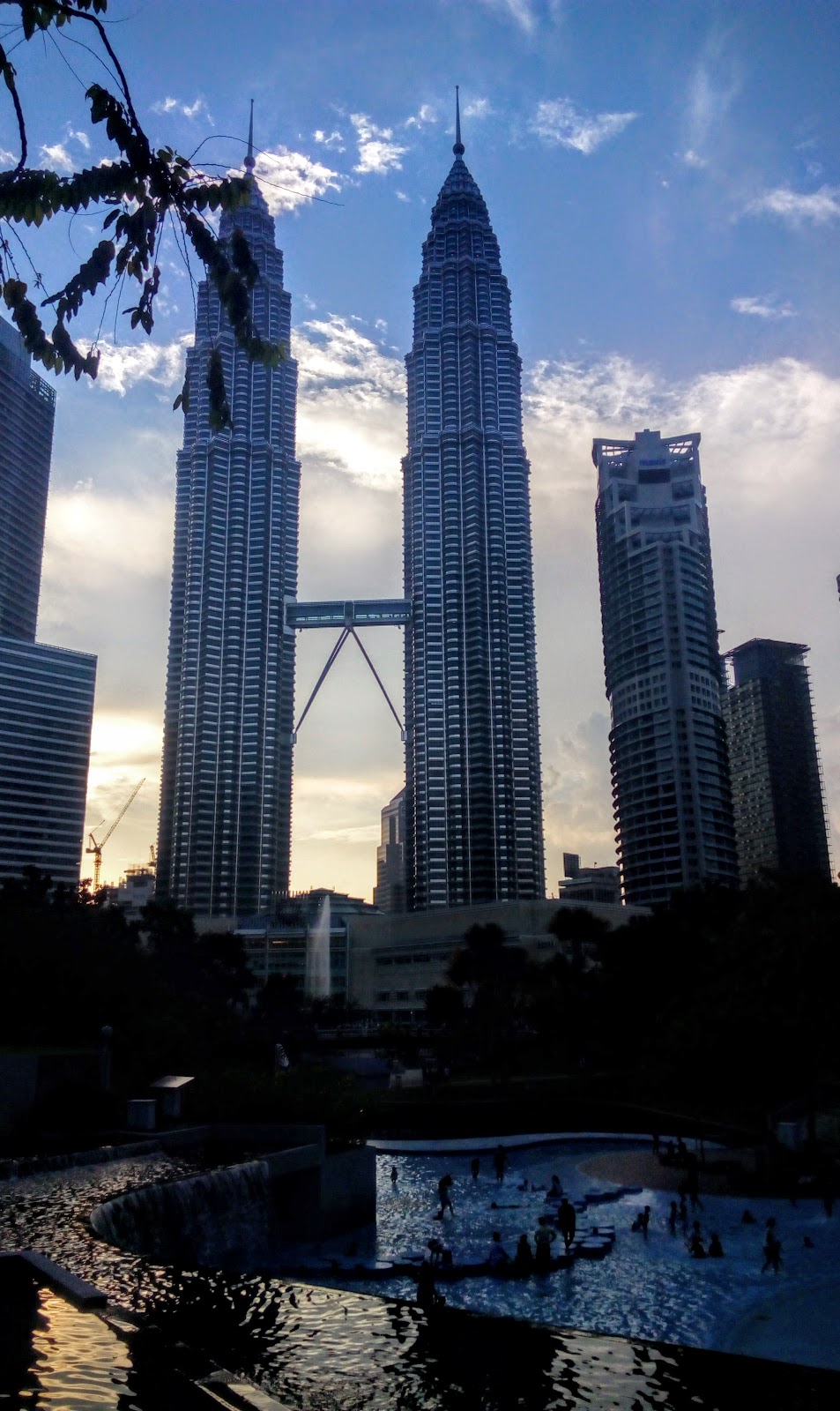
But then I realised I had missed an obvious, easy attraction: the Petronas towers. I had decided when planning for KL that I would not bother ascending the tower to see the view, as the tickets were expensive and necessitated queuing early in the morning to purchase one before they sold out. Furthermore, the one building that I would want to see from a high vantage point such as the Petronas towers would be glaringly absent from the skyline, as I would be standing within them. So all I wanted to do was go see the towers, take a few photographs, and return home. Easily achieved within the remaining two hours of daylight. 


After a brief journey on the free GO KL bus service, and then a short walk along raised walkways and through a mall (seemingly everything in the Golden Triangle is 'through a mall', as every time I went there, I took shortcuts through malls), I emerged in KLCC park, which was flanked by gleaming, piercing skyscrapers.


KLCC stands for Kuala Lumpur Convention Centre, which is nearby/under/around/in somewhat proximate to the Petronas Towers. 


I soon easily spotted the towers among the urban jungle, and decided as the sun was setting roughly behind them, I should find a quiet spot and wait out the sunset with a cold bottle of water and some BBC new articles. 


Yes, I am boring, but I am also poor and so that is all the entertainment I can afford. If this were Thailand, there would be hookers and beer without a doubt.


Soon enough, I became bored, so indulged in some selfies.


The sunset was slow in coming, and did not really produce the picture I wanted to take, but I still enjoyed relaxing in the park, and admiring the gleaming, steel towers as the sky was burnished orange behind them. 


After several uneventful hours in a park (travelling for me is always action-packed and glamorous), I had to rush off as I was running late for a date. 


Yes, I went on a date. With a Malaysian guy from Melacca. We went out to grab some local food near to his neighbourhood, and I had a really delicious meal whilst he berated me on not having eaten enough of Penang's local food, and educated me about his culture and life.


It was nice, he was pleasant, but he was not my type. 


However, seemingly, I was having a good night that night, because upon returning to my hostel, I got talking to a Spanish guy in the common area. After chatting for a while, it transpired we were both interested in guys, and he invited me out for a drink.


It was nice, he was pleasant, and he was my type. 


...


DSP


PS: I may have bought myself a late birthday present in the form of a larger-than-life, 2ft tall plush Pikachu. Yes it was a stupid idea, but it cost only Rm30 (£5) and is amazing in every way.


Useful Information:
Transport:
  • My luxury bus (I did not ask for luxury, it's just what I'm given) cost Rm41 (£7) which included a transfer from the hostel.
Accommodation:
  • For my first night, I stayed in Fernloft KL, which was a dump. It cost me RM28.50 (£5), which was far more than advertised on Hostelworld, as they don't include tax, fees, towel hire, and the charge for being permitted to breathe their air in their quoted price. It looked alright initially, as they make you pay before giving you mould-spotted linen. Gross.
  • On the days when my gracious Couchsurfer was not able to host me, I stayed at Grocers Inn on Jalan Sultan, which was so cheap at RM15 (£2.50) for a fan dorm, but was reasonably clean and the staff friendly. 
Attractions:
  • Sri Maha Mariamman temple is on Jalan Tun H S Lee, and is free to enter, when it is open. Nearest metro station is Pasar Seni LRT.
  • Guan Di Chinese temple is also on Jalan Tun H S Lee, and is also free. Nearest metro station is Pasar Seni LRT.
  • Petronas towers are expensive to climb but free to photograph. Accessible via KLCC 


Monday, 13 July 2015

Penang, Part 4: The mighty Kek Lok Si temple.


(Day 4) 27th June 2015


Second blog written today. I am on a roll. It's probably because I am spending ludicrous amounts of Singaporean dollars on expensive lattes and cakes. 


Huh...where is your budget you say? I do not have a clue. I feel I left it at Singaporean immigration. ;)


I had initially planned to leave Penang on the morning of my fourth day there, as I felt I had seen everything worth seeing, and all of my dorm buddies had left, to be replaced by five British girls who helped justify my dislike for British travellers under twenty-five.


(I pretended I was French when they tried to talk to me, and turned out the dorm light when they came back in at 01:00, and decided that was a perfect time to repack their backpacks. Surprisingly, they did not attempt to talk to me again. Good.)


However, the day before, on the way to the foot of Penang Hill, I had spied this temple in the distance. 


It looked so beautiful perched above the valley.


This was Kek Lok Si temple, and upon hearing how much Indre and Isaac had enjoyed visiting it, I decided I would spend an extra day in Penang and visit it in the morning early afternoon, and then catch up on blogging in the afternoon. Having gone through bus-related hell the night before, it would also be nice to use my hard-won knowledge.


An hour by bus later, I was stood at the foot of the temple's hill. I had read that the route up to Kek Lok Si was well hidden, so I turned into a non-descript alleyway roughly where I thought I should turn off the road, and sure enough, the alley widened and was soon lined by stalls selling snacks and tacky Chinese souvenirs.


Yup, this was the right turning.


The secret passage.


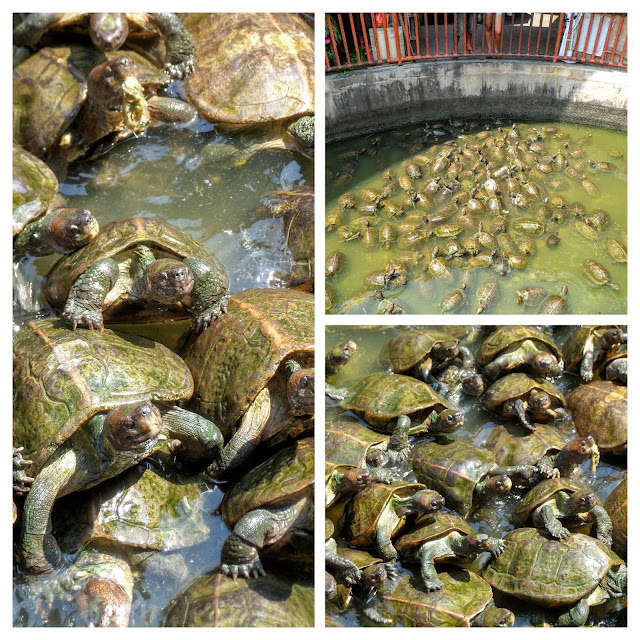
After a gentle ten minute climb through the shop-lined tunnel, the alley split around a circular space with a barrier around it. Upon reaching it, I looked down to see a pool filled with turtles. 


So many grumpy, wrinkly faces.


There were hundreds of them, sitting in the soupy, green water staring longingly at a man selling greenery with which tourists could feed them. I felt bad for their less-than-ideal confinement, but thought I could help at least by feeding them some greenery. 


I then continued to climb up through more shops and restaurants until I eventually emerged in the old prayer hall, where there were the standard elements of a Chinese temple: wishing ribbons and their accompanying trees; gaudy deities illuminated by neon lighting; and hundreds of candles with their flames spluttering in the light wind.


Walking back out of the prayer hall into the bright sunshine, I turned a corner to see that the temple peak still loomed far above me.


Retracing my steps slightly, I found a path that lead higher into the sprawling complex, past pagodas, pools, and (sadly) beggars who lined the sloping path between the temples.


I am far from miserly, but I do have an objection giving to beggars in most situations. That business man at the train station who asks for a pound because he has lost his wallet, I have no problem giving money to him. A lot of homeless beggars in the UK I have little time for, but I will occasionally buy Big Issues off of those who sell them. But beggars in South East Asia particularly I have no time for. I watched a Thai women in Udon Thani collect over 100B (£2) in around an hour from passersby, which I would expect is much less than the waiting staff who walked around her serving customers earn per hour. I have had to step over a man sprawled out in the middle of Jalan Petaling in Malaysia who just shook his plastic cup without even looking at me because he was too busy playing Candy Crush (or equiv.) on his smartphone. In this part of the world, religion encourages generosity and support, and I feel at times people abuse that generosity. 


Rant over.


Pagodas and temples.


I felt increasingly lost and confused when I walked through a circular arch into a flower garden which surrounded a small, gaudily-painted temple.


There were impressive views from the balcony at the far end of the garden.


But there was still so far to go to reach the top of the temple.


I continued climbing through the maze of temples and altars, and eventually found myself in a huge souvenir shop where I spotted signs stating 'Lift to Pagoda'. That sounded positive, and when I realised I would be travelling by inclinator (fancy word for a lift that travels diagonally  along a slope rather than vertically), I happily paid the RM6 return to try it.


It was remarkably unexciting and slow, but the operators had packed it so full that I was unable to photograph it's unremarkableness. It was just a very slow lift that saved me from a ten minute hike up the hill.


At the top of the temple, I exited the lift and walked through yet another shopping complex before emerging in the sunshine before this behemoth.


The solid-bronze statue, depicting Kuan Yin the Goddess of Mercy, stood over thirty metres tall, and dwarfed all the other buildings in the complex. Unfortunately this was as close as you could get, as the pagoda that housed it was being renovated, and was closed to the public. However, I was content to have just finally reached the peak of the temple I had seen the day before, and had taken over an hour to find.


I wandered around the other temples, and sat by the obligatory pond filled with koi carp, before descending in the inclinator (perhaps I should say diagonaling in the inclinator?) back to the lower level of the temples, to begin the twisting walk back into the town.


Emerging out of the shaded alley into the sun at the base of the temple, I walked through a wet market, and found myself an iced coffee to enjoy before walking to the main road to catch a bus back to the city centre.


Now I had spent nearly an hour yesterday confounded by the confusing bus routes in this part of this city. I had learnt that buses returning to the city run both ways along Ayer Itam Road, and you need to know which number runs which way to make sure you hail the right one down. I thought I had mastered this, but it still took thirty minutes for a bus to stop and let me aboard. I just think the bus drivers cannot be bothered to deal with tourists sometimes. 


Back in the city, I spent a lazy afternoon blogging in several cafes near to the hostel, and then for dinner sampled the street food from about four different stalls at the end of the street, before returning to the blogging. It was uneventful but productive.


Late afternoon on Lebuh Cinta (Love Lane).


Tomorrow, I would start my adventures in KL (Kuala Lumpur). Whether I produce a blog covering that tomorrow is less certain. I have a flight to catch and, well, sleeping to do.


DSP


Useful Information:
  • Kek Lok Si is located in Ayer Itam, to the west of central Georgetown, and not far from the base of Bukit Penang. 
  • There are buses that run from KOMTAR and Terminal Weld up to the temple's base, but I do not recall the bus number, and it may not be helpful anyway as the buses are very bizarre in Penang. Just know that you can flag them down anywhere, but they will only stop to let you off at designated bus stops.
  • My bus cost RM2 each way.
  • Kek Lok Si is free to enter, but the inclinator costs RM3 each way, and avoids a long walk up a steep road to the temple's peak.