Showing posts with label Penang. Show all posts

Monday, 13 July 2015

Penang, Part 4: The mighty Kek Lok Si temple.


(Day 4) 27th June 2015


Second blog written today. I am on a roll. It's probably because I am spending ludicrous amounts of Singaporean dollars on expensive lattes and cakes. 


Huh...where is your budget you say? I do not have a clue. I feel I left it at Singaporean immigration. ;)


I had initially planned to leave Penang on the morning of my fourth day there, as I felt I had seen everything worth seeing, and all of my dorm buddies had left, to be replaced by five British girls who helped justify my dislike for British travellers under twenty-five.


(I pretended I was French when they tried to talk to me, and turned out the dorm light when they came back in at 01:00, and decided that was a perfect time to repack their backpacks. Surprisingly, they did not attempt to talk to me again. Good.)


However, the day before, on the way to the foot of Penang Hill, I had spied this temple in the distance. 


It looked so beautiful perched above the valley.


This was Kek Lok Si temple, and upon hearing how much Indre and Isaac had enjoyed visiting it, I decided I would spend an extra day in Penang and visit it in the morning early afternoon, and then catch up on blogging in the afternoon. Having gone through bus-related hell the night before, it would also be nice to use my hard-won knowledge.


An hour by bus later, I was stood at the foot of the temple's hill. I had read that the route up to Kek Lok Si was well hidden, so I turned into a non-descript alleyway roughly where I thought I should turn off the road, and sure enough, the alley widened and was soon lined by stalls selling snacks and tacky Chinese souvenirs.


Yup, this was the right turning.


The secret passage.


After a gentle ten minute climb through the shop-lined tunnel, the alley split around a circular space with a barrier around it. Upon reaching it, I looked down to see a pool filled with turtles. 
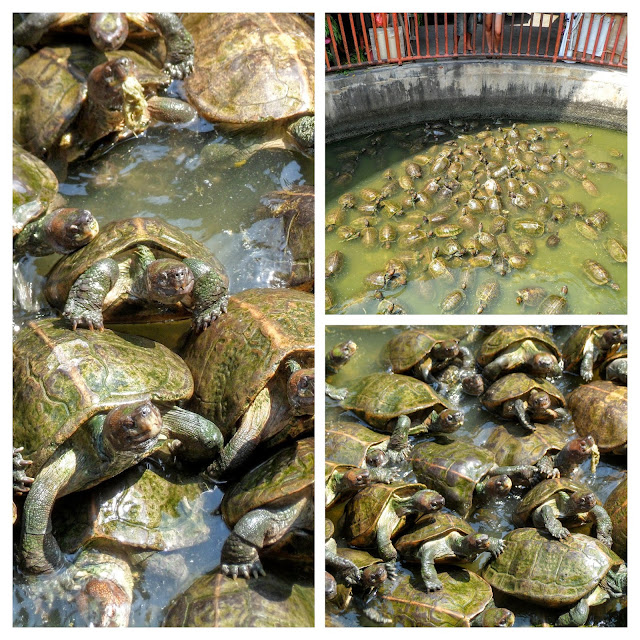

So many grumpy, wrinkly faces.


There were hundreds of them, sitting in the soupy, green water staring longingly at a man selling greenery with which tourists could feed them. I felt bad for their less-than-ideal confinement, but thought I could help at least by feeding them some greenery. 


I then continued to climb up through more shops and restaurants until I eventually emerged in the old prayer hall, where there were the standard elements of a Chinese temple: wishing ribbons and their accompanying trees; gaudy deities illuminated by neon lighting; and hundreds of candles with their flames spluttering in the light wind.


Walking back out of the prayer hall into the bright sunshine, I turned a corner to see that the temple peak still loomed far above me.


Retracing my steps slightly, I found a path that lead higher into the sprawling complex, past pagodas, pools, and (sadly) beggars who lined the sloping path between the temples.


I am far from miserly, but I do have an objection giving to beggars in most situations. That business man at the train station who asks for a pound because he has lost his wallet, I have no problem giving money to him. A lot of homeless beggars in the UK I have little time for, but I will occasionally buy Big Issues off of those who sell them. But beggars in South East Asia particularly I have no time for. I watched a Thai women in Udon Thani collect over 100B (£2) in around an hour from passersby, which I would expect is much less than the waiting staff who walked around her serving customers earn per hour. I have had to step over a man sprawled out in the middle of Jalan Petaling in Malaysia who just shook his plastic cup without even looking at me because he was too busy playing Candy Crush (or equiv.) on his smartphone. In this part of the world, religion encourages generosity and support, and I feel at times people abuse that generosity. 


Rant over.


Pagodas and temples.


I felt increasingly lost and confused when I walked through a circular arch into a flower garden which surrounded a small, gaudily-painted temple.


There were impressive views from the balcony at the far end of the garden.


But there was still so far to go to reach the top of the temple.


I continued climbing through the maze of temples and altars, and eventually found myself in a huge souvenir shop where I spotted signs stating 'Lift to Pagoda'. That sounded positive, and when I realised I would be travelling by inclinator (fancy word for a lift that travels diagonally  along a slope rather than vertically), I happily paid the RM6 return to try it.


It was remarkably unexciting and slow, but the operators had packed it so full that I was unable to photograph it's unremarkableness. It was just a very slow lift that saved me from a ten minute hike up the hill.


At the top of the temple, I exited the lift and walked through yet another shopping complex before emerging in the sunshine before this behemoth.


The solid-bronze statue, depicting Kuan Yin the Goddess of Mercy, stood over thirty metres tall, and dwarfed all the other buildings in the complex. Unfortunately this was as close as you could get, as the pagoda that housed it was being renovated, and was closed to the public. However, I was content to have just finally reached the peak of the temple I had seen the day before, and had taken over an hour to find.


I wandered around the other temples, and sat by the obligatory pond filled with koi carp, before descending in the inclinator (perhaps I should say diagonaling in the inclinator?) back to the lower level of the temples, to begin the twisting walk back into the town.


Emerging out of the shaded alley into the sun at the base of the temple, I walked through a wet market, and found myself an iced coffee to enjoy before walking to the main road to catch a bus back to the city centre.


Now I had spent nearly an hour yesterday confounded by the confusing bus routes in this part of this city. I had learnt that buses returning to the city run both ways along Ayer Itam Road, and you need to know which number runs which way to make sure you hail the right one down. I thought I had mastered this, but it still took thirty minutes for a bus to stop and let me aboard. I just think the bus drivers cannot be bothered to deal with tourists sometimes. 


Back in the city, I spent a lazy afternoon blogging in several cafes near to the hostel, and then for dinner sampled the street food from about four different stalls at the end of the street, before returning to the blogging. It was uneventful but productive.


Late afternoon on Lebuh Cinta (Love Lane).


Tomorrow, I would start my adventures in KL (Kuala Lumpur). Whether I produce a blog covering that tomorrow is less certain. I have a flight to catch and, well, sleeping to do.


DSP


Useful Information:
  • Kek Lok Si is located in Ayer Itam, to the west of central Georgetown, and not far from the base of Bukit Penang. 
  • There are buses that run from KOMTAR and Terminal Weld up to the temple's base, but I do not recall the bus number, and it may not be helpful anyway as the buses are very bizarre in Penang. Just know that you can flag them down anywhere, but they will only stop to let you off at designated bus stops.
  • My bus cost RM2 each way.
  • Kek Lok Si is free to enter, but the inclinator costs RM3 each way, and avoids a long walk up a steep road to the temple's peak.


Penang, Part 3: Let's see some sights!


(Day 2) 26th June 2015


Yes, I realise I am...sixteen days behind. Wow so far behind I have to count on my fingers. Right, to the writing and photo-ing!


After a brilliant night's sleep in the chilly, pitch-black dorm of the Old Penang Guesthouse, I was ready to get out and tick some more sights off from my handwritten guidebook. I also marvelled that I did not have a hangover, and decided to get out of the hostel before it could catch up to me. So with Indre and Kaitlyn (Michael and Thomas had disappeared early in the morning on a ferry to Langkawi) we headed out bright and early (11am) to see more of Penang. 


First up was the colonial area to the north of the city centre, which was markedly unphotogenic, except for the Church of St. George whose picture I included in the post before last. 


We had intended to visit Fort Cornwallis, which was built soon after the British arrived on Penang as a way to secure their conquest purchase of the island. My guidebook said it cost only RM2 (£0.34) to enter, but when we arrived at the gate, the boards said ticket price was RM20, so we promptly walked away. 


Here is at least a picture of some cannons and decaying fort wall.


As Fort Cornwallis was a bust, we headed back into the city in search of the Penang Peranakan Museum.


Found it!


Peranakan, or Baba Nyonya refers to a cultural group unique to the colonial British Straits Settlements of Penang, Malacca and Singapore, which are ethnically a mix of Chinese and Malay heritage, and whose traditions incorporate those heritages whilst also maintaining dress, cuisine and  habits distinct from either group. Peranakans are gradually disappearing as their children abandon their complex traditions for those of Malay or Chinese Malaysians, which is exacerbated by a distinct lack of government recognition or support in both Malaysia and Singapore. Before beginning my research on Malaysia, I had never heard of this culture, and I was eager to learn something about it before it disappeared for good.


I liked the guardian lion with a ribbon around its neck.


The mansion was...strange. It was a bizarre syncretism of British colonial stained glass and architecture and Chinese gilded screens and furniture. 


I would not wanted to have lived somewhere decorated in this way, but it distinctiveness made the house interesting to explore. 


So many gilded bird motifs!


There was very British stained glass windows, and the owners had glassware collections like those in British manors, but everything was subtly different from British examples.


The house had an open atrium in the centre of the house which helped illuminate the inner rooms, and made the house feel light and welcoming. It really was a beautiful place to wander around slowly (I walked especially slowly wherever there was an AC unit) and take in the atmosphere. 


The good light did not help produce a good photo here. I like my shoulders here though ;)


Better, but shoulders are worse :(


In addition to the mansion itself, there were also galleries stretching through what once would have been stables and servant quarters which displayed the extensive jewellery collections once possessed by the ladies of the house. Neighbouring the mansion was a small, ornate personal Chinese temple, which did not want to photograph from the outside, but produced at least something acceptable on the interior.


After a short pit-stop back at the French patisserie from yesterday (which I cannot recall the name of, and is not on Google) where we tried almost every cake they had on offer, we walked to the entrance of Khoo Kongsi, arguably the most impressive Chinese temple within the city. Indre, put off my paying for another attraction, decided to do some souvenir shopping instead, but Kaitlyn decided she had not yet reached temple fatigue levels, and joined me.


As the temple straddles one side of a courtyard only accessible by narrow alleys. After paying, we followed the alleyway around a corner, and emerged in the courtyard, and were amazed by our initial view of the temple. 


It certainly had the wow factor. 


Sitting in front of the temple were several carved lion guardian statues.


Aside from always having hilariously gormless expressions, I like playing with the stone balls in their mouths (...there was no way for that not to sound dirty. You have a dirty mind for going there. Naughty!) that act as their (mobile) tongues. It is a bit of a bad habit, but a habit nevertheless.


Next to one of the lions there was a yellow sign that drew my attention.


Oops...


He is just asking for it though. 


After I had finished being inappropriate with the lions' granite balls, I focused on the temple, and the beautiful, intricate decoration that covered its roof and eaves.


Inside the intricacy continued with the walls covered in beautiful drawings of what I believe are guardians or deities.


By far the most beautiful element of the temple for me were the delicate stone relief carvings that decorated the front wall of the temple, under the eaves and behind the intricate railings. They had not been painted in gaudy golds, blues and reds like much of the temple, but rather had been subtly accentuated by turquoise, brown and yellow, which came together unexpectedly in a delightful way.


The temple took very little time to explore, and soon we were back out on the street, and heading towards the nearby bus terminal to take a bus to Bukit Penang.


We were very briefly distracted for two hours by the dozens of pieces of street art that crowded the streets around Khoo Kongsi, and spent at least two hours some time trying to find as many murals as possible.


See the previous blog post for more street art and street ramblings. 


As much as the street art was fascinating, the afternoon was getting on, and we therefore needed to get on a bus to make it to Bukit Penang before sunset.


A bus.


One hour later saw us arrive at the base of Penang hill feeling slightly sleepy after such a long bus ride. From there we had to take the funicular railway up the hill to its summit.


I had read on several reviews and blogs that there was a cable car as well, but I could not see any signs for it when I arrived. However, when I got onboard the train, I realised that the train was attached to a cable beneath the tracks that pulled it up and lowered it down the hill. So, in a slightly unusual way, it was a cable car.


After a short five minute journey, we stopped at the summit, and we exited the station to these amazing views of Georgetown sprawling through the valleys beneath Bukit Pinang.


Here you can faintly see the mainland city of Butterworth across the sea from Georgetown.


It seems to have become a necessity whilst I visited Penang that I had a banana-themed dessert each day. Or at least that's what I told myself when we ordered a banana split to share.


Kaitlyn cannot take photos...yeah...blame the photographer not the subject ;)


The views atop the hill really were spectacular, and before descending we decided to see if we could take some shots of us with the spectacular scenery in the background. The hill however was unsympathetic to our idea, and had very few spots where you photo the amazing view and an amazing person together.


We eventually found this stone ledge containing a flower bed. Beyond this stone ledge was a 30-40 foot drop.


I do not like heights. 


It is not very visible in this photo here, but my knees were shaking for each photograph, and when Kaitlyn was not taking a photo, I was holding onto the tree just behind me.


Soon enough we headed back down the hill, and I decided I wanted a seat at the front of the funicular so I could watch the descent from a better viewpoint. To get a good spot, we were forced to elbow-barge a couple of very, very pushy Chinese toddlers.


That's a lie. I told Kaitlyn to elbow past them, but she was too considerate, and let them past, which meant we had to stand up the whole way. I tried explaining that pushing children over is acceptable in China, but she did not believe me ; ) 


When we returned to the base of the hill, we thought it would be an easy matter to find a bus to take us back to the city centre. I decided as there was no imminent sign of a bus that we could walk down the road in search of food, and flag the bus down if and when it turned up. I found a brilliant local food court where I had this strange noodle dish (well, it was a noodle dish covered in pak choi and this half-cooked egg soup-sauce), and then we walked along what we thought was the bus route, and found a bus stop in the fading light.


It was then that a 'helpful' Indian gentleman started talking to us, and told us we needed to be on the other side of the road, the side of the road that went back towards Bukit Pinang. We were confused but saw no reason to disbelieve him as he was obviously local. I double-checked with a passing bus, and indeed the driver said to wait on the other side of the road. So we crossed,  but were mystified when the buses on this side of the road shook their heads and told us to stand back on the other side of the road. The Indian gentleman had stopped being helpful and had started begging for money.


After around thirty minutes of waiting in the dark on the side of the road with an very persistent beggar, I saw a bus approaching with a number I recognised, and we were so thankful when the driver nodded and said he was heading into Georgetown.


I eventually realised that buses to Georgetown can run either way along the road, and you just need to know which number runs which way so you catch it in the right direction. So confusing.


We arrived back at the hostel about three hours later than planned, and headed out almost immediately with Indre who had been waiting to have dinner with us. We found a little love-themed cafe along Love Lane, had several helpings of fries, and then I spent the remainder of the evening relaxing with some Youtube and free water.


DSP


Useful Information:

Tourist Attractions:
  • Fort Cornwallis costs RM20 to enter, and I cannot see how it justifies such a high price. 
  • Penang Peranakan Museum also costs RM20, but I found it interesting and extensive enough to warrant this price. It is still overpriced though. Allow around an hour to visit the house, temple and jewellery galleries. 
  • Khoo Kongsi temple costs RM10, and is by far the most impressive Chinese temple in Penang that I saw. The entrance fee also puts off most tourists so it is blissfully quiet and you can explore it at your own pace. Allow thirty minutes.
  • Penang Hill funicular costs RM30 return. I can see a potential for queuing at times, but we had to wait only five minutes each time.


Saturday, 11 July 2015

Penang, Part 2: Art on the streets


(Day 2) 26th June 2015


Part of the appeal of the island of Penang, and the capital city Georgetown, was their alternative, artistic vibe. This was most obviously expressed in the art installations and graffiti scrawled all over the city. In fact, there was so much of it, I thought I would put it all into a separate post, rather than interrupting another post with dozens of photos.


Yes, there will be dozens of photos, but very little writing, I promise (*crosses fingers*).


I initially just stumbled upon the painting and structures by accident, with no intention of seeking additional ones out. However, on my second full day in Georgetown, as Kaitlyn and I walked from Khoo Kongsi temple to the Terminal Weld bus station (more of that in the next post), we walked down a street with around five examples of street art, all within site of each other. 


Kaitlyn had a map showing the location of much of the city's street art, and proposed that we postponed the bus trip to Bukit Penang, and spent an hour or two trying to find as many of the examples on the map as we could. 


The street art map.

I had no objections to this, as I like street art, I like map reading, and I like treasure hunts (which this was as the map was frequently unclear on locations).


Let's go find some street art!!!


One of my favourites - you can sit on the saddle of the bike to pose for a photo.


Much of the street art on the map was in a similar style, and often employed real life props into the art, so that the art was half-drawn, half-real. 


Bruce Lee does not like cats!


Such an adorable one, and very well hidden down an alleyway.


In addition to these realistically painted children pieces, which seemed to be to be painted by one artist, there were many other more unusual pieces of graffiti scattered in amongst them.


Unsure if these are revolutionary or religious cats.


The colours here are not quite right.


The purple boy was one of my favourites, and covered a whole side of a building.


I really like that much of the art was interactive, which was an excuse for me for many gratutious selfies.


In my defence, Kaitlyn took more than me!


Erm, unsure what the lady behind me is doing.


I was supposed to be deafened by the minion. However...it looks...inappropriate.


Second attempt, not much better.


I want a dog that big. I could ride him and feed him dinosaur steaks.


That's one huge cat.


The cat only made sense, when you looked around the corner.


There was a slight cat theme.


Ultimately we managed to find over half of those listed on the map, and many, many more besides. Seemingly, the initial installations encouraged others to decorate the nearby streets, and there are now paintings and murals around every corner in this part of town.


More widely spread than the street art were the metal, graffiti-style, informative sketches of everyday life and history of Georgetown. I presumed that these were commissioned by the local government, and they were very helpful as well as amusing, and so I felt I should include all those that I found below.


Cheeky!

That all for the street art. 


Next up, probably Kuala Lumpur. Or maybe more Penang. I have not decided exactly how I will structure the blog that precedes this. Yes I am doing things out of order. This was an easy post to produce. So I did this one first. ;)


DSP


Useful Information:

  • The street art is concentrated along Lebuh Armenian, and most can be easily found without needing the street art map, though for a few the map is needed (Bruce Lee was particularly difficult to find). The map is available at Penang Heritage Trust, and at the tourist information centre.